











































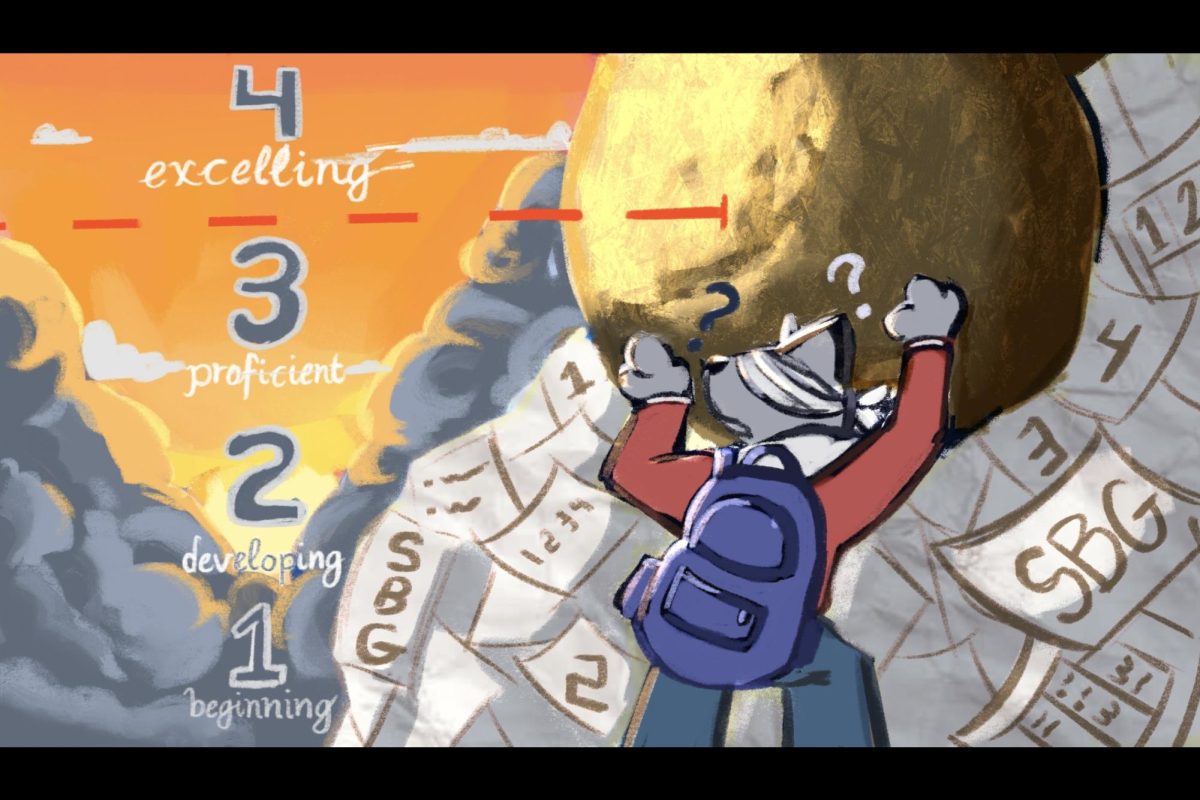
Northwood’s near-universal 4- or 5-point standards-based grading scale was meant to evaluate student performance on skill mastery over content memorization. While SBG makes grading more objective, it doesn’t always accurately reflect what students truly know, especially since the system is still being implemented and refined.
Standards-based grading, just as the name suggests, evaluates comprehensive student performance by breaking it down into skill-based criteria instead of a composite grade for the entire assignment.
However, although standards are more specific in each class, the threshold to score a certain letter grade in each class varies dramatically. For example, in AP U.S. History, the threshold to score an A is a 3.26, whereas, for AP Computer Science Principles, the threshold is a 3.71. This makes it very confusing for students to navigate multiple different syllabuses with different grading scales to try to assess their chances of getting an A. The grading scale also makes it harder for parents to understand and navigate their students’ gradebook.
As part of improving SBG, there should be more communication between departments to standardize the rigor and grading structure so that the grading scales can be normalized. However, such change would take significant time and feedback from students, so it is important that feedback be collected and used to slowly refine the system so that it is more friendly for students and parents.
While SBG has its issues, the system should only be refined rather than discarded, due to its benefit of allowing better standardization of rubrics.
According to English teacher Erik Emery, this helps teachers give specific feedback to students on areas for improvement and enables teachers to better optimize lessons to focus on skills that are shown to be weak across all classes. When asking for help, students are now more inclined to ask skill-based questions and receive specific feedback instead of just “What can I do better?”
“[SBG] is supposed to make it more clear what to do to achieve certain levels,” Emery said. “We’ve even heard this in what students talk about since, at least now, [they] talk more about their skills rather than just a grade that may not have as much precise meaning.”
Specifically for Humanities classes, SBG reduces the possibility of grading perceived as based on “whether the teacher likes you or not,” as teachers must adhere to a universal rubric that is decided by the entire department. Teachers also meet to standardize grading scales so that grading is unbiased across all periods of the same class.
For many students, however, the ultimate question is whether it is easier to get an A in percentage-based grading or in SBG.
Typically, there is not much difference between the grade distribution in a percentage-based grading system and SBG. This is because SBG scales are designed to reflect similar grade intervals compared to percentages, where a 60% translates to a 1, 70% to a 2, 80% to a 3 and 90% to a 4 in most classes.
What about the extreme cases where students are 1-2% short of an A? If a student scores an 89 out of 100 on a quiz, their standards-based grade would theoretically translate to a “proficient” or a 3. Under the percentage-based system, their grade would be 89% or a B+. If the student gets a 90% score on the next test of the same weight, their total SBG grade would be 3.5, or an A in most SBG classes. Their percentage grade, on the other hand, would be 89.5%, still a B+.
Northwood also doesn’t distinguish between A-, A and A+ when calculating GPAs, thus reducing the importance of the decimal-point differences between a standards-based grade and a percentage-based grade for students concerned about their academic standing.
Since Northwood’s standards-based system is still in its first stages, its long-term impact on student performance remains to be seen. Regardless, it is a change that brings hope of Northwood’s competitive environment becoming more focused on genuine learning rather than just a letter grade.