







































In the age of surveillance, developing privacy literacy—knowing how to control what data are collected by apps—is essential to staying safe in cyberspace. IUSD should equip students with this skill by providing concise, student-readable summaries of privacy policies and settings for each of its approved apps.
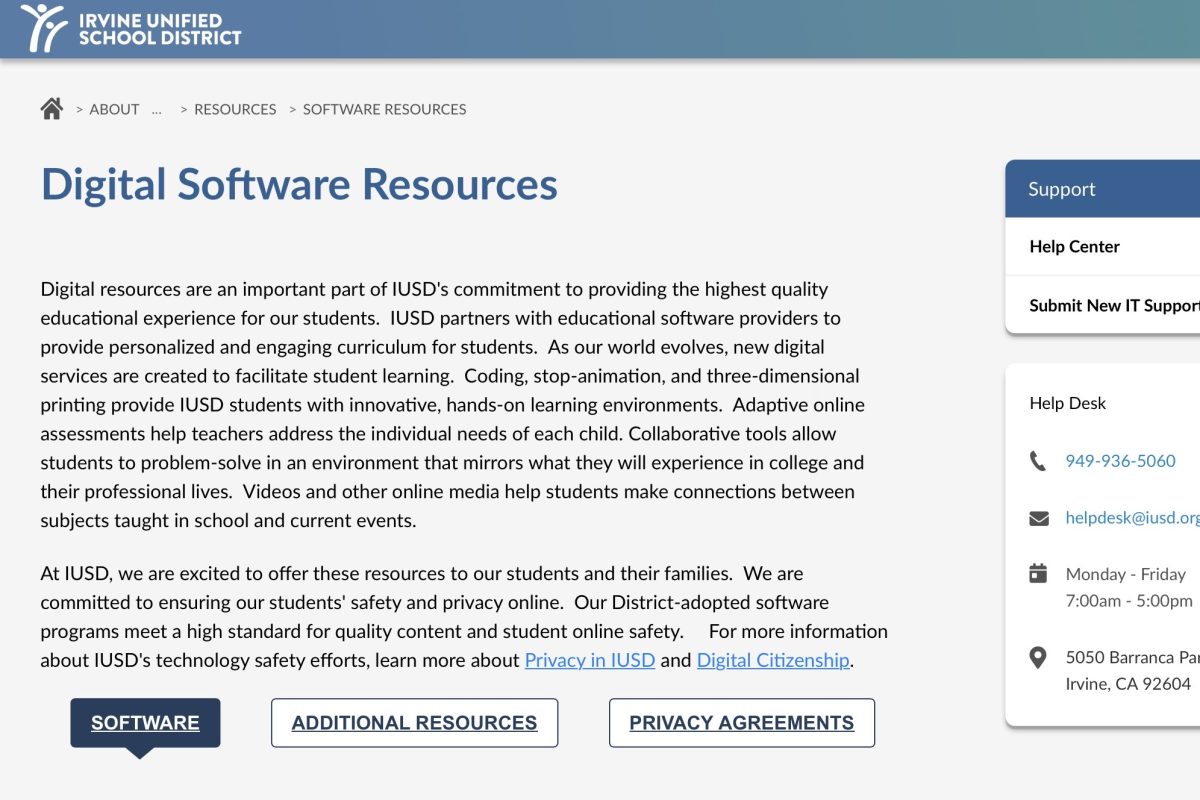
IUSD already maintains a district Digital Software Resources page stating that district-contracted software providers have agreed to protect student data and meet state requirements under California Education Code section 49073.1 and federal requirements under FERPA, as well as a general privacy page describing the district’s approach to student-data protection. Also, all third-party applications are required to sign a vendor agreement about adhering to IUSD regulations.
“The district has every interest in making it as transparent as possible,” said Brianne Ford, IUSD’s Assistant Superintendent of Information Technology. “We also don’t want to overwhelm folks or think that data’s being shared in ways that it’s not.”
But expecting students to practice privacy literacy by reading full privacy policies is unrealistic. Summarizing privacy disclosures in easy-to-read documents is a crucial first step toward helping students distinguish which settings (location, camera, microphone, etc.) are essential for functionality.
While some may be concerned that simplifying complex data flows into one-pagers can unintentionally misrepresent an app’s features, this risk is manageable with routine updates. Summaries can be updated to reflect new features or revised privacy policies on the same schedule as approvals and renewals.
This is feasible on a district-wide scale. For example, New York City Public Schools publishes a parent-facing vendor directory that includes approved apps, their reason for accessing certain metadata, privacy limits and more.
IUSD can implement this approach by attaching a short summary to each required app. The summary should include basic information such as the purpose for collecting certain data, the privacy settings available, a visible “last updated” date and a link to the district agreement for full details.
Students should be informed participants in—not passive users of—digital spaces. Student-readable summaries make privacy expectations legible: what data moves, what stays limited and what students can control before they click “allow.”
For more information about IUSD’s data policies, visit the software page at iusd.org/software or reach out to [email protected].