








































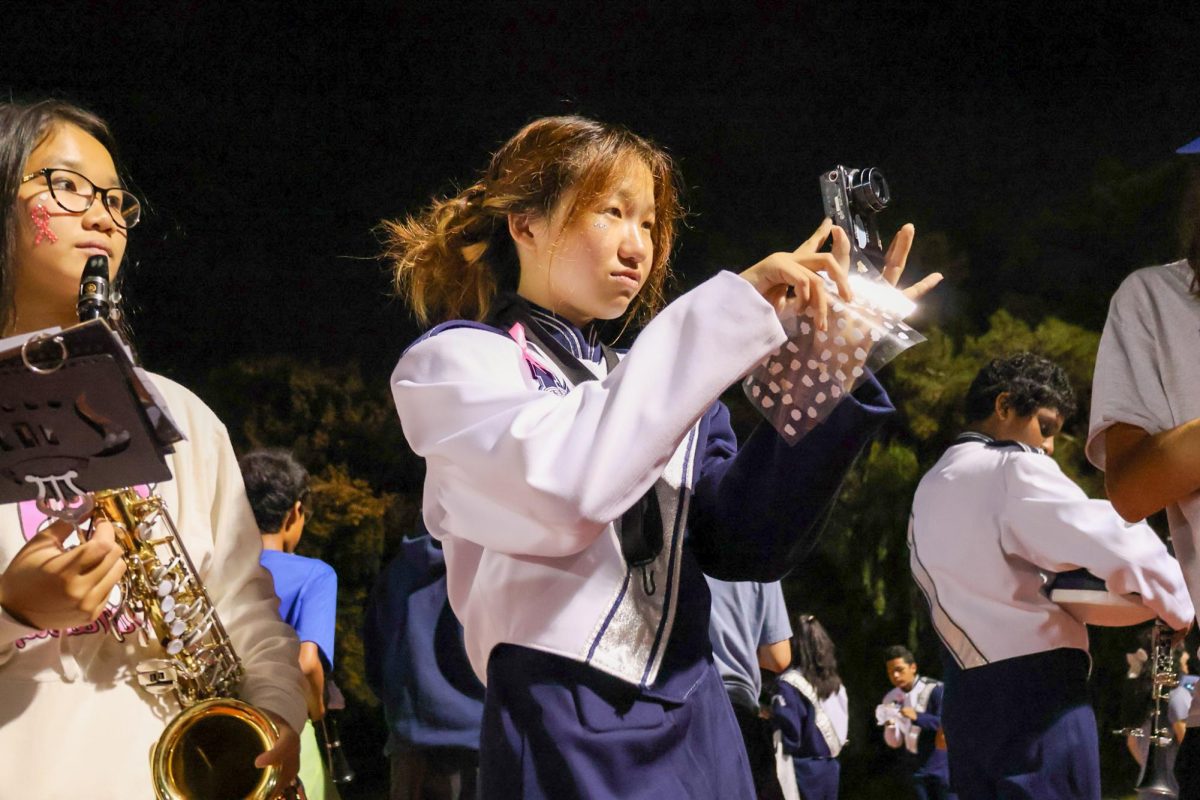
Students across campus have dug into their ever-deepening piles of antiquated technology, side-eyeing the baby photos, aka prospective profile pictures, on their newest-oldest device. Upon taking that relic of formerly cutting-edge consumer photography into the real world, they begin to hear the magic words: “Wait, can you take a photo of me?”
2000s digital cameras are back. They don’t have AirDrop to share pictures instantly and don’t have ultrahigh resolution—but that’s part of the appeal. Defined by a blown-out flash look, an orange timestamp and a grainier aesthetic textured gold at sunset and muddled hazy at midday, digicams trigger nostalgia.
“When I look through my photos that I’ve taken, I just feel like I’m traveling back to my childhood,” sophomore Grace Chow said. “Modern technology is really cool toned in a way. It sometimes doesn’t capture the warmness of life.”
Chow uses her mom’s old Canon Powershot A2000 IS digicam to capture sunset photos with her color guard friends at marching band events, occasionally also posting cat photos or videos on a dedicated Instagram account, @chowder.cam. In addition to ease of use, she said her digicam enabled her to capture more memories without the harsh quality often created by phone cameras’ flash.
“The personal aspect [of digicams] increases as you take more memories on it,” Chow said. “It becomes full of your past and things that you can look back on.”
Especially in settings where smartphones are banned, such as during marching band performances at football games, digicams offer a practical alternative. Marching band xylophonist junior Ben Sriprapundh keeps his in the sleeve of his uniform.
“[With my phone,] I’d be worrying about my SAT scores and all that stuff, but where’s the fun in that?” Sriprapundh said. “[A digicam] breaks boundaries, right? You can capture moments that you wouldn’t be present enough to see.”
Calling himself his “friends’ candid photographer,” Sriprapundh adopted one of his dad’s digicams as his own to surprise friends with pictures to document their experiences. He said the conspicuousness of a digicam photo, reinforced by their sudden flash, encourages subjects to come back to see the result, sometimes more than a year later.
“It’s kind of like being a dad when on a family trip and you have to tell your kids to pose in front of certain things,” Sriprapundh said. “They’ll be like, ‘Oh, I don’t really want to,’ and then afterwards, they’ll look back on it and they’ll like it. It’s that ability to have those special moments with them while we still have our youth that’s good for me.”
Beyond just dodging phone restrictions, digicams help people savor a genuine version of youth untouched by AI tools that erase imperfections in photos. Digicams—golden grain and all—are the raw expression of this generation’s yearning to live in, as Chow says, a slower world.
“They’re not only the trend of 2025 or the 2000s,” Chow said. “It’s just a very beautiful way to capture memories … Not everything is go, go, go, go. You can breathe and take your time with life.”